The Edible-Only Garnish Myth
The edible-only garnish myth overlooks aroma and visual cues. Learn how to use non-edible finishes clearly, so diners know what belongs on the plate.
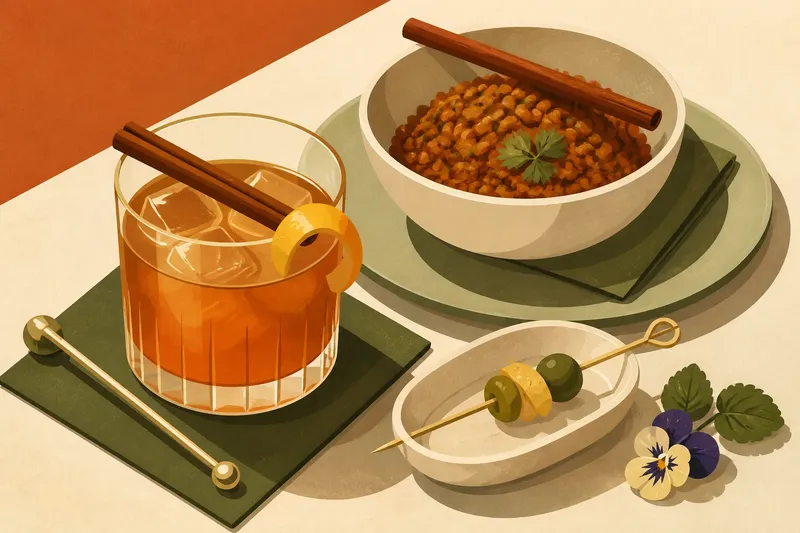
A cocktail arrives with a cinnamon stick balanced across the rim, and the first question is not about its flavor. It is whether the stick is meant to be chewed. The edible-only garnish myth says every finishing touch should be food. In practice, some garnishes are there to signal aroma, shape or mood rather than to be eaten. Their place depends on whether diners can tell what they are for.
A garnish can address more than taste
A garnish may add flavor when eaten, but it can also offer a scent before the first sip, draw the eye to a component, or mark a serving as distinct. A cinnamon stick in warm cider can suggest spice before it is tasted. A decorative cocktail pick can hold fruit in place while keeping it out of the drink until the diner chooses to use it.
These jobs overlap, but they are not interchangeable. An edible piece of fruit can be both decoration and a snack. A clean, food-safe flower may add color and can be eaten, though some flowers are unsuitable for food. A metal skewer can guide the eye and hold ingredients together, but it is a tool, not a bite. Calling all three “garnish” does not make their purposes equally obvious.
That distinction matters because the setting invites assumptions. A small object placed on food or beside a drink looks like part of the serving. Diners may reasonably wonder whether to eat it, move it, or leave it alone. The aim is not to forbid non-edible finishes; it is to make their role legible without requiring a conversation.
Non-edible finishes still need a clear purpose
A non-edible garnish earns its place when it contributes something that an edible ingredient cannot provide as neatly. A glass stirrer can keep layered ingredients available to mix. A decorative pick can hold a garnish above the liquid. A small, food-safe ornament may give a drink a visual cue tied to its flavor or occasion. In each case, the object should have a visible job, not merely occupy space.
Consider a shallow bowl of spiced lentils served with a cinnamon stick laid across the rim. If the stick is intended only to scent the steam, placing it where it is clearly separate from the food makes that purpose easier to read. If the diner is expected to stir with it, the presentation should make that action apparent. The same object can serve different functions, but a design that leaves the diner guessing is doing too little communicating.
Think of a garnish as a small sign beside a doorway: useful when it points somewhere, distracting when it looks like decoration without a purpose. This does not mean every plate needs a label. It means placement, material and context should work together so the intended action is reasonably clear.
Placement can explain what should happen
The simplest distinction is often physical. Food meant to be eaten belongs among the edible components or on a serving pick that makes it easy to remove. A non-edible object is better kept at the rim, on a separate holder, or in another position that does not make it look like an ingredient. Avoid burying an inedible item in food, where a diner may discover it only by biting down.
Scale and texture also send signals. A small, soft leaf placed with a salad reads differently from a rigid wooden skewer crossing a cup. A paper umbrella can be recognized as decoration by many diners, but it may still be unclear whether it is safe to put near the mouth. Familiarity is not universal, and a setting that relies on local custom may confuse visitors.
When a finish could reasonably be mistaken for food, a short verbal cue can help: “The cinnamon stick is for aroma; the drink is ready as served.” That is clearer than a vague warning such as “Don’t eat the garnish,” which leaves the diner to work out which part is meant. In a restaurant, a menu note may suit a recurring presentation; for a single serving, a concise explanation at the table is enough.
Choose edible and non-edible materials deliberately
Edible garnishes should be selected as food, not merely as objects that happen to look appetizing. Use ingredients intended for eating and prepared for that purpose. An attractive leaf, blossom or decorative berry is not automatically suitable for consumption. The name and source of a plant can matter, as can how it was grown and handled.
Non-edible elements need their own standards. A cocktail pick should be designed for food service, clean and stable in the drink. A decorative object should not shed fibers, paint or loose parts into a meal. For a scented element, keep it from touching food unless it is suitable for that contact. If diners are likely to handle an object, its edges and position should not create an avoidable snag or poke.
Labels, manufacturer instructions and local food-service rules determine which materials are suitable for contact with food and how they should be used. When those details are uncertain, choose a simpler finish rather than improvising with a craft item or a plant of unknown identity.
Say a host wants to serve a chilled drink with a decorative wooden pick and an olive. The pick is intended to hold the olive, not to be eaten. Placing the olive at the end and setting the pick across the rim makes the division visible; a brief note lets guests know the pick is a utensil. The expected result is a drink that still looks finished without asking anyone to bite into the wrong material.
What do diners usually want to know?
Does every garnish need to be edible?
No. A garnish may provide scent, structure or a visual signal without being food. It should be placed and presented so diners can recognize that role.
How can a diner tell whether a garnish is edible?
Look at its material, position and relation to the food, but do not assume appearance settles the question. If it is unclear, asking the server or host is sensible.
Should an inedible garnish touch the food?
Usually, keeping it separate makes its purpose easier to understand. Any contact with food should be appropriate for the material and the way it is used.
Can a garnish serve as both decoration and utensil?
Yes, if the object is suitable for that use and its function is clear. A pick that holds an olive, for example, can be decorative while also helping the diner lift the olive from the glass.
Clarity is part of the presentation
A polished finish does not have to be edible, but it should not turn the meal into a guessing game. Use an edible garnish when the ingredient itself belongs in the flavor and texture of the dish. Use a non-edible one when its aroma, structure or visual cue has a clear purpose that food cannot serve as well.
For a quick decision, ask what the garnish contributes, whether its material is suitable for that role, and whether a diner can identify what to eat without hesitation. The edible-only garnish myth is not corrected by adding more elaborate decoration. It is corrected by making each finishing touch honest about what it offers—and clear about what it is not.